Plate I Histology of the nervous system of play

Spike.

grow a nervous system

Wire small spiking neural circuits and watch them run a body. Sensory cells to interneurons to motor pools, and a leg kicks, a lamprey swims, a heart answers a stand-up, a leech heart beats in turn.

Every neuron is a real NEST model, simulated live inside the game in NEST's own names and units: mV, ms, pA, nS, Hz.

Alpha Playable on desktop Linux, rough in places. Tell us what broke or confused you.

Fig. 1. A lamprey swims on a half-centre oscillator: left and right pools inhibit each other and tire, so they take turns. Live, at true speed.
15
chapters in three wings: the body, a Bestiary, Theory
29
cell types from NEST and NESTML, integrate-and-fire to Hodgkin-Huxley
1 ms
closed loop: circuit and body step together
0
numbers in a verdict: it says what is missing, never the answer

What it is

A bench, a body and the scopes between them

Each level gives you sensor and motor cards and an empty bench. You add neurons, drag connections and set weights; the circuit runs against a simplified body, one millisecond at a time, and you read what happened from the same instruments a physiologist would.

The Spike lab running the lamprey level: the circuit of stained neurons on blue graph paper at left, the swimming lamprey, a score gauge, a spike raster, voltage traces and motor output bars at right, and the level brief below the circuit
Fig. 2. The lab on the lamprey level, with the reference circuit running.
  1. The bench. Neurons are stained somata on engineering graph paper: sienna excites (an arrowhead), Prussian blue inhibits (a bar, ⊣). A firing cell spreads a wash of stain.
  2. Parts and wiring. Pick a cell type from the parts bin, add excitatory or inhibitory groups, noise, connections.
  3. The body. Here a toy lamprey whose muscles the motor pools drive. Elsewhere a limb with spindles, a heart with blood pressure, lungs, an eye, a gut, a fly's heading.
  4. The gauge and the verdict. A running score and a sentence about what the circuit is doing, in words.
  5. The spike raster. Every spike of every cell, grouped by population.
  6. The scopes. Membrane potential traces, in mV, and the rates on each motor channel.
  7. The brief. One new idea per level, what to build and what passes. The numbers are in a recipe that costs a star.

What you actually do

Six verbs, one circuit at a time

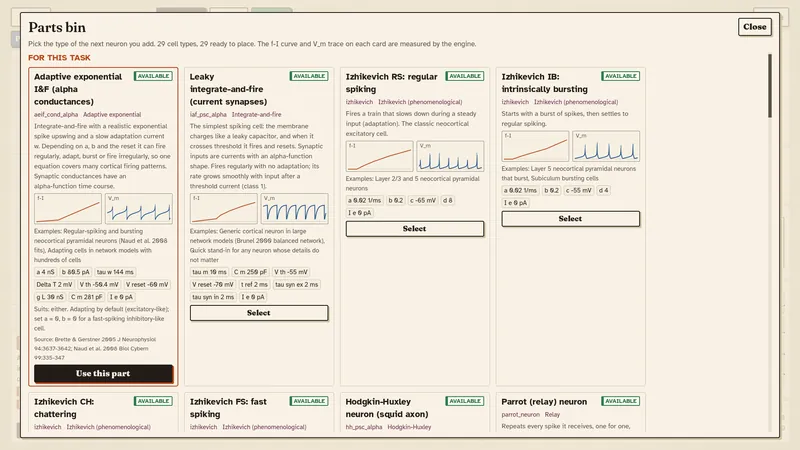
The parts bin open in the lab: cards for adaptive exponential, leaky integrate-and-fire and Izhikevich cells, each with a measured f-I curve and a voltage trace

I. Build

An empty bench with the level's sensor and motor cards. Add cells from a parts bin of NEST and NESTML models (integrate-and-fire, adaptive exponential, Izhikevich, Hodgkin-Huxley, an SA-node pacemaker, a brainstem burster, a crab STG cell), drag connections, set weights.

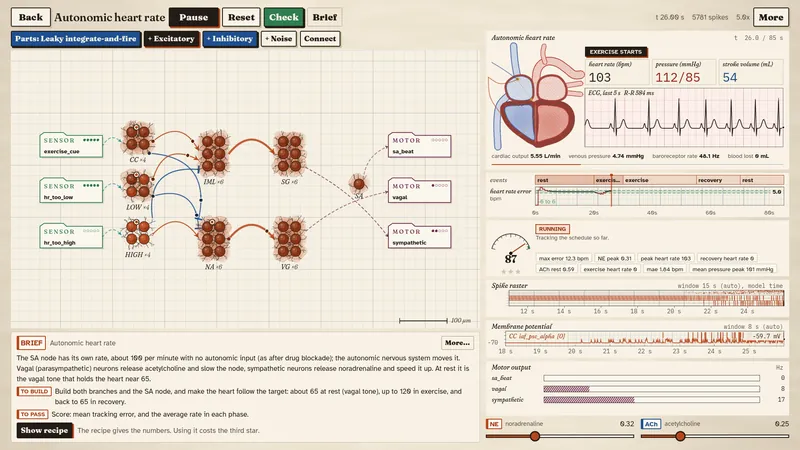
The autonomic heart level running: a drawn heart with heart rate, pressure and stroke volume readouts, an ECG strip, and the circuit of sympathetic and vagal pools

II. Run

A live spike raster, voltage traces, gauges and the body itself: a limb, a heart with blood pressure, lungs, an eye, a gut, a swimming lamprey, a crawling worm, a fly's compass.

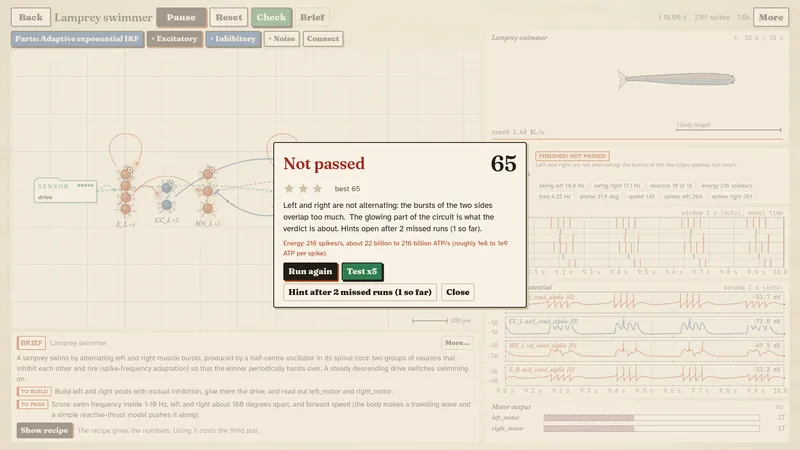
A CHECK result card reading Not passed: left and right are not alternating, the bursts of the two sides overlap too much

III. Check

Instant headless scoring over several seeds. The verdict says what your circuit did and which part of the mechanism is missing, never the answer.

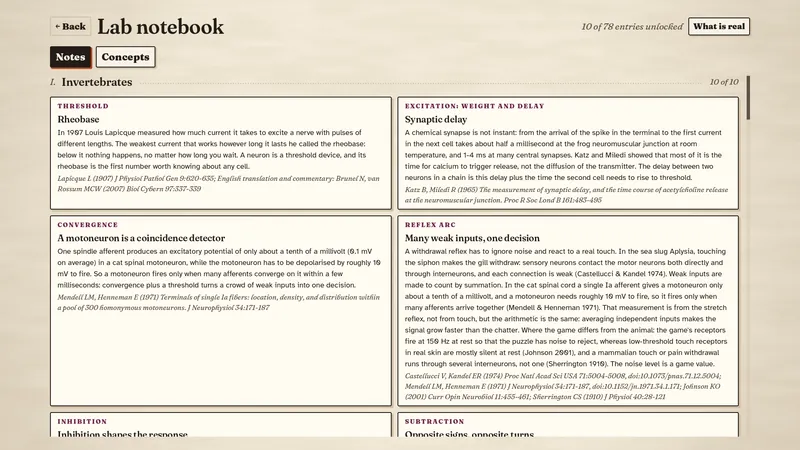
The lab notebook: cards on rheobase, synaptic delay, coincidence detection and the reflex arc, each with its citations

IV. Learn

One new idea per level, a three-tier hint ladder, a recipe you can buy with a star, a lab notebook of cited findings and a glossary of concepts.

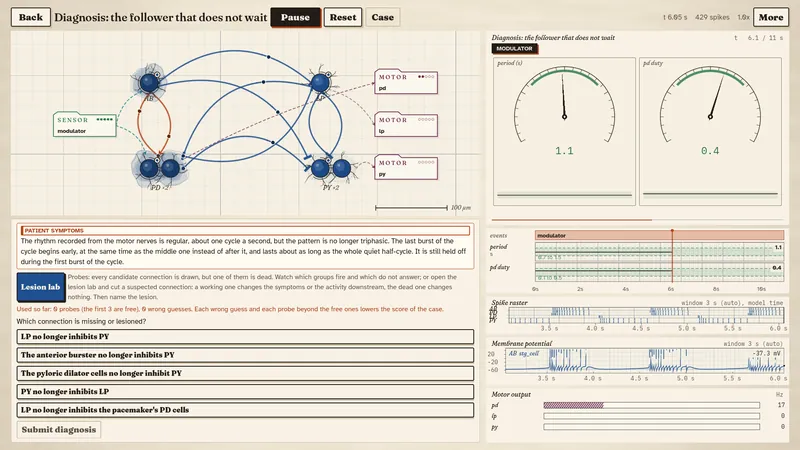
A diagnosis case on the crab pyloric circuit: patient symptoms, a probe counter, the lesion lab button and five candidate lesions to choose from

V. Diagnose

A patient's circuit with a hidden lesion and a list of symptoms. Probe it with the scopes and the lesion lab, then name the broken connection. Fewer probes, better score.

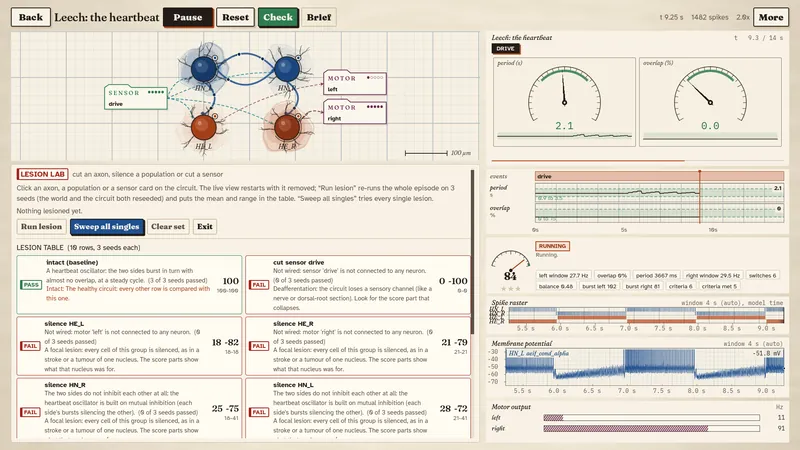
The lesion lab on the leech heartbeat: a table of single lesions swept over several seeds, with the score of each

VI. Dissect

A lesion lab with multi-seed re-runs, a motif census, burst and heart-rate-variability analysis, phase-response curves, a spike-triggered average and an energy bill.

The campaign

Three wings of an atlas

Every chapter is a hand-inked plate with its levels pinned to the anatomy: micro-puzzles that teach one idea each, a scored task, and diagnosis cases. Three modes change tolerance and noise, never the circuit: Guided, Standard and Researcher.

Plates I–V

The body

Five chapters climb from a single cell crossing threshold to a whole day of autonomic control: 19 micro-puzzles, 14 tasks, 2 bosses and 6 diagnosis cases.

  1. Invertebratesreflexes, a swimming rhythm, a nose for salt
  2. Spinal cordstretch, hold and reach
  3. Hearta pacemaker, the autonomic nerves, the baroreflex
  4. Breathinga bursting brainstem network tuned by CO2
  5. Autonomicpupil, gut, fight or flight
Plate III. The heart chapter: levels pinned to a drawn heart, nerves and node.

Plates VI–XI

The Bestiary

A chapter per model organism, built around the circuit neuroscience knows best. Open from the start. Each has micro-puzzles, the animal's behaviour as a scored task, and diagnosis cases on its circuit.

VI. C. elegans. Touch the head and it backs up, touch the tail and it goes: a command switch wired from the real connectome.
VII. The leech. Two heart interneurons that burst in turn: a half-centre with a slow cycle.
VIII. The sea slug. A reflex that habituates, recovers and is sensitised, all in one synapse.
IX. The fly's compass. A bump of activity on a ring holds the heading in the dark and turns with the fly.
X. The mushroom body. A sparse odour code, and a dopamine-gated depression that teaches the fly to avoid an odour.
XI. The crab. A conductance-based pacemaker kernel and two rebound followers make the pyloric rhythm.

Plates XII–XV

Theory

What a computational-neuroscience course teaches, in four chapters of three levels, with lab views of their own: a live phase plane, rate strips, a pattern grid and a tuning ring. Plus a spike-triggered average in the Analysis screen.

XII. Dynamics. Class I and II onset, a fixed point that ends firing, one neuron that remembers a pulse.
XIII. Rate models. A Wilson-Cowan pair that oscillates, a winner that holds, a spiking network against its mean field.
XIV. Attractor memory. A whole recalled from a part, two memories without blends, a memory written by plasticity.
XV. Tuning and decoding. A cell tuned by its inputs, tuning sharpened by competition, a direction read from a crowd.

See it run

Real circuits, running bodies

Captured from the released game, at the speed shown in the corner of each lab. Clips play while they are on screen; with reduced motion turned on they wait for you.

Fig. 3. The heart. Sympathetic and vagal pools steer a sinoatrial pacemaker; exercise starts and the rate climbs.
Fig. 4. The baroreflex. The body stands up, blood pools, pressure falls; the brainstem circuit pulls it back within seconds.
Fig. 5. The stretch reflex. A tendon tap stretches the muscle, spindle Ia afferents fire, the motoneurons answer and the antagonist is held off.
Fig. 6. The leech heartbeat. Two heart interneurons inhibit each other and burst in turn; each releases its own side's motor neuron.
Fig. 7. The fly's compass. A bump of activity moves round a ring of sixteen cells as the fly turns in the dark.
Fig. 8. The phase plane. Nullclines and fixed points from the cell's live parameters; a pulse throws the trajectory onto a firing loop.
Fig. 9. The pyloric rhythm. Conductance-based STG cells start up and the raster fills with the triphasic pattern.
Fig. 10. CHECK. The episode is scored headless over the level's seeds and the result lands like a stamp.

Every clip and screenshot, with notes →

Honest by design

A cheap trick that hits the numbers fails

  • The mechanism is checked, not the output. Every level checks the mechanism it teaches through the circuit's structure: a swim without crossed inhibition does not pass, however well it wiggles.
  • A table of cheap circuits must fail. Each level has one, in the test suite, and the reference circuit must pass on several seeds.
  • Verdicts carry no numbers. Neither do the first three hint tiers. The verdict says what the circuit did and what is missing.
  • Sources are checked. Citations are verified against PubMed with DOIs, and generated histograms are labelled as generated, not as other players.
Fig. 11. The same lamprey without its crossed inhibition: not passed, and the verdict says why.

Plate VI of the game Sources and simplifications

What is real here

Spike is built on real neuron models; the bodies and the circuits around them are simplified. A page in the game and in the docs says, layer by layer and level by level, which of five labels applies.

NEST
The equations are NEST's own, unmodified. Checked by golden checksums and PyNEST parity.
NESTML re-fit
A cell written in NESTML for the game, structure from a paper, numbers adjusted by hand. Not validated against recordings.
Tuned in silico
Chosen by sweeping until the level passed: circuit weights, delays, gains, pass bands.
Illustrative
A body coefficient picked so the module behaves plausibly. Shapes are tested; values are not fitted.
Generated
Produced by a script: the post-solve histograms are variants of the reference, not players.

Read What is real, level by level →

Download

Free, no account

The latest build is on GitHub Releases.

Linux x86_64 · zip · glibc 2.39 (Ubuntu 24.04 or newer) Extract, then run Spike.x86_64

Windows is planned: the missing piece is cross-building NEST. Each release lists its files on GitHub; the game reads and writes only its own folder under ~/.local/share.

Run from source

Build it yourself

Needs a C++20 compiler, CMake 3.24+, static GSL, Python 3 and Godot 4.7.

git clone https://github.com/ixaxaar/spikes
cd spikes
scripts/build-all.sh --tests   # NEST (pinned), NESTML cells, engine, extension, tests
godot --path godot

Or in Docker: docker build -t spike-build . && docker run --rm -v "$PWD":/src spike-build scripts/build-all.sh --tests. Packaging, tests and custom cells: docs/BUILD.md.

A circuit is data

One JSON file that the game, the C++ engine and the Python package all read, so a circuit built in the game runs unchanged in PyNEST, with identical spikes.

import spike                           # python/
net = spike.build("my_circuit.json")   # the file you saved in the game
spikes = spike.run(net, 1000.0)

Read more

The wiki

How to play, what each wing teaches, the cells in the parts bin, and how the simulation works underneath.

Open the wiki
  1. Start herethe wiki's index
  2. See it in actionevery clip and screenshot
  3. What is realNEST, re-fitted, tuned, illustrative
  4. Changelogwhat landed, what is known broken
  5. Source on GitHubengine, game, Python package
  6. Issuesbugs, confusions, ideas